BECE mock exam

Science — Palm & cedar Super Mock April 2026

60 questions to work through. Answer them here, or take the whole thing timed with an account.

1. [1]

BECE mock · Science

The following statements are all reasons why air is not an element except
2. [1]

BECE mock · Science

Which of the following is used directly during respiration?
3. [1]

BECE mock · Science

Which of the following instruments does not depend on pressure for its operation?
4. [1]

BECE mock · Science

Which of the following is true of the image formed by an object placed in front of a plane mirror? The image
5. [1]

BECE mock · Science

Why is crop rotation important? It
6. [1]

BECE mock · Science

Which of the following conditions is a symptom of food poisoning?
7. [1]

BECE mock · Science

A particle changes its velocity from 10 ms^-1 to 15 ms^-1 in 8 seconds. Determine its acceleration.
8. [1]

BECE mock · Science

A farming method that is regarded as environmentally friendly is
9. [1]

BECE mock · Science

A simple electrical circuit has a voltage supply of 12 V. If the total resistance in the circuit is 6Ω, determine the current in the circuit.
10. [1]

BECE mock · Science

Which of the following relationships represents a food chain in a fish pond?
11. [1]

BECE mock · Science

If the cock to hen ratio in a school farm is 1:15, determine the number of cocks required to serve 60, 000 hens.
12. [1]

BECE mock · Science

Seed is the planting material for propagation of the following crops except
13. [1]

BECE mock · Science

Which of the following substances is a naturally occurring weak acid?
14. [1]

BECE mock · Science

Which of the following devices operates by going through the following energy transformation? Electrical energy → kinetic energy → sound energy
15. [1]

BECE mock · Science

Use the activities below to answer questions 15 and 16. I. Incineration II. Biogas production III. Recycling of waste IV. Compost preparation Which of the activities results in the production of manure?
16. [1]

BECE mock · Science

Use the activities below to answer questions 15 and 16. I. Incineration II. Biogas production III. Recycling of waste IV. Compost preparation Electric power can be generated by
17. [1]

BECE mock · Science

During formation of rainbow, the rain droplets that hung in the sky serve as
18. [1]

BECE mock · Science

Which of the following gases is needed for the manufacture of starch by aquatic plants?
19. [1]

BECE mock · Science

Which of the following material is magnetic?
20. [1]

BECE mock · Science

Which of the following statements about a forward-biased p-n junction diode is/are correct? I. p-type semiconductor is connected to the positive terminal of the cell II. p-type semiconductor is connected to the negative terminal of cell III. n-type semiconductor is connected to the positive terminal of cell
21. [1]

BECE mock · Science

Chloride ion has
22. [1]

BECE mock · Science

An employed individual can be employed in industry in the
23. [1]

BECE mock · Science

A force of 30.0 N moves a body through a distance of 1.5 m in the direction of the force. Calculate the work done
24. [1]

BECE mock · Science

Which of the following compounds is not ionic?
25. [1]

BECE mock · Science

Which of the following properties is characteristic of pure metals?
26. [1]

BECE mock · Science

The vertical cross-section through the soil showing distinct soil layers is known as soil
27. [1]

BECE mock · Science

The electronic configuration of Potassium is
28. [1]

BECE mock · Science

Which of the following groups of crops are correctly matched to its examples?
29. [1]

BECE mock · Science

Use this information to answer questions 29 and 30. A patient's urine was tested in the laboratory using both Fehling's solutions A and B and the colour changed from blue to brick red, indicating the blue litmus. What can be inferred from the above observation?
30. [1]

BECE mock · Science

Use this information to answer questions 29 and 30. A patient's urine was tested in the laboratory using both Fehling's solutions A and B and the colour changed from blue to brick red, indicating the blue litmus. What disease is the patient likely to be suffering from?
31. [1]

BECE mock · Science

Which of the following methods best controls bacterial diseases?
32. [1]

BECE mock · Science

The main reason for using plastics to manufacture certain parts of farm tools is to
33. [1]

BECE mock · Science

Which of the following statements about the diagram is or are correct?
Diagram for question 33
34. [1]

BECE mock · Science

Which of the following factors should be considered the most when preparing ration for a farm animal?
35. [1]

BECE mock · Science

A force of 150 N is exerted on an area of 0.2 m^2. Determine the pressure
36. [1]

BECE mock · Science

Methane is an example of a covalent compound because it
37. [1]

BECE mock · Science

Oil applied to the surface of water kills mosquito larvae through
38. [1]

BECE mock · Science

Sound energy can be converted to electrical energy by
39. [1]

BECE mock · Science

Which of the following effects are associated with late harvesting of maize? I. Increase in crop yield II. Rain may cause grain to rot III. Weevils may attack and destroy grain IV. Exposure of maize to attack by birds
40. [1]

BECE mock · Science

Land and sea breezes occur as a result of
41. [10]

BECE mock · Science

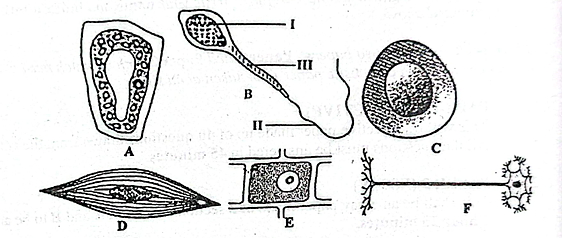
The diagram is an illustration of specialized cells found in living things. Study it carefully and answer the questions that follow: (i) Explain the term specialized cells. (ii) Give one function of each of the cells labelled B, E and F. (iii) Give one adaptation each of the cells labelled A and C. (iv) State one function of the parts of cell B labelled I and II. (v) Which of the cell(s) in fig. 1(a) is/are found in flowering crops? Give a reason to support your answer.
Diagram for question 41
42. [10]

BECE mock · Science

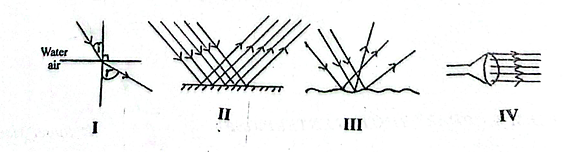
The diagram illustrates various scientific phenomena demonstrating properties of light. Study it carefully and answer the questions that follow: (i) Explain the bending of the light ray as it moved from water to air as shown in I. (ii) Differentiate between the scientific phenomena illustrated in II and III. (iii) Name two natural occurrence that can be explained by the scientific phenomenon illustrated as IV. (iv) State two applications of the scientific phenomenon illustrated as I.
Diagram for question 42
43. [10]

BECE mock · Science

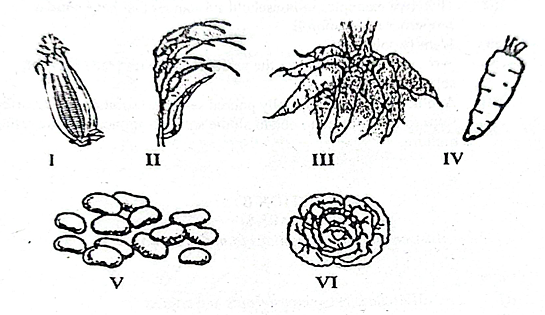
The images below is an illustration of various crops grown on farms in five different vegetation zones in Ghana. Study it carefully and answer the questions that follow: (i) Identify each of the crops labelled I, II, III, IV, V and VI. (ii) Classify the crops identified into root tubers, leafy crops, cereals and leguminous crops. (iii) Name the planting material for crop labelled I. (iv) Which of the crops is directly involved in the nitrogen cycle? (v) Identify any two crops which are annual crops.
Diagram for question 43
44. [10]

BECE mock · Science

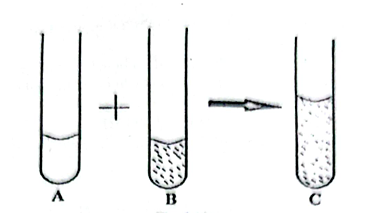
The Figure shows an experiment performed by students of Prakoso D/A J.H.S to show the neutralization reaction of solutions A and B after they were combined to form solution C. A piece of blue litmus paper was dropped into solution B turned red. Study it carefully and answer the questions that follow: (i) Give three physical characteristics of solution A. (ii) Give two examples of household substances that have similar properties as solution B. (iii) Give the properties of solution C. (iv) Write a word equation for the reaction that takes place between solutions A and B. (v) Another student accidentally poured sand into solution C. Describe steps to be followed to obtain all the sand components of the mixture.
Diagram for question 44
45. [5]

BECE mock · Science

Give: (i) two differences between asteroids and comets (ii) three uses of artificial satellites
46. [4]

BECE mock · Science

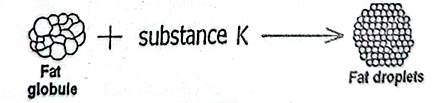
The figure illustrates the breakdown of a certain food substance in the alimentary gut of humans. Study it carefully and answer the questions that follow: (i) Identify substance K in the human body (ii) What organ secretes substance K in the human body? (iii) Name the part of the gut where the biological process illustrated occurs (iv) Explain the importance of the process in the digestion of fat.
Diagram for question 46
47. [5]

BECE mock · Science

(i) Explain subsistence farming (ii) List the two main ways a farmer will sow his seeds in his backyard farm (iii) State one basic farm tool used to carry out the following activities: (a) making mounds and earthing up (b) digging and uprooting root stumps
48. [5]

BECE mock · Science

(i) Define element (ii) Find the number of neutrons of atom M (iii) What is the number of electrons of atom Y? (iv) Which of the atoms will form a positive ion when the atoms are chemically combined? (v) By identifying atoms Y and M, give the systematic name of the compound between atoms M and Y
49. [5]

BECE mock · Science

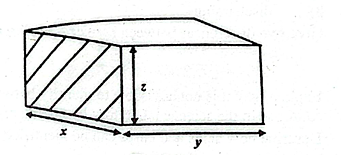
(i) Define the term pressure (ii) The Figure is an illustration of a regular concrete block of weight 60 N with dimensions x = 2.0 m, y = 4.0 m and z = 1.5 m. Find the greatest pressure exerted by the block
Diagram for question 49
50. [3]

BECE mock · Science

(i) How will you identify sunken seed bed on a vegetable farm? (ii) Give two advantages of sunken seed beds
51. [4]

BECE mock · Science

(i) Explain the following terms as related to periodic chemistry (a) Period (b) Group (ii) Give two examples of halogens
52. [5]

BECE mock · Science

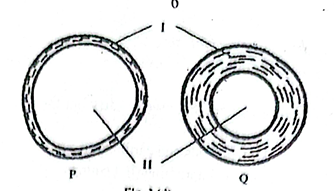
The figure is an illustration of the transverse section of two major types of blood vessels in the human body. Study it carefully and answer the questions that follow: (i) Give three structural differences between P and Q (ii) State the type of blood mainly transported by each of the blood vessels P and Q (iii) Name the network of blood vessels that connect both P and Q in the human body (iv) Give the structural adaptation of the blood vessels named in (iii) for its major role
Diagram for question 52
53. [6]

BECE mock · Science

(i) Explain the following actions of a capacitor (a) charging (b) discharging (ii) Give two differences between forward biasing and reverse biasing
54. [4]

BECE mock · Science

(i) Explain why it is not advisable to identify between acidic or alkaline solutions in the science laboratory by tasting or touching (ii) Describe how acids and bases can be identified in the science laboratory
55. [6]

BECE mock · Science

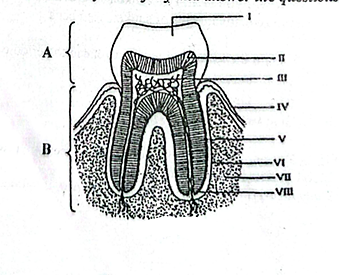
The figure is an illustration of internal structure of a tooth found in the lower jaw of humans. Study it carefully and answer the questions that follow: (i) Identify the tooth above (ii) Give one reason to support your answer (iii) Give one function of each of the parts labelled I and II (iv) Name two diseases that affect the teeth in the figure
Diagram for question 55
56. [5]

BECE mock · Science

(i) Name two biological agents that affect formation of soil (ii) Describe the nature of clayey soil in three ways
57. [6]

BECE mock · Science

(i) Classify each of the following substances as acidic, basic or neutral; seawater, tomato juice, bicarbonate of soda, toothpaste (ii) Give two characteristics of colloids
58. [5]

BECE mock · Science

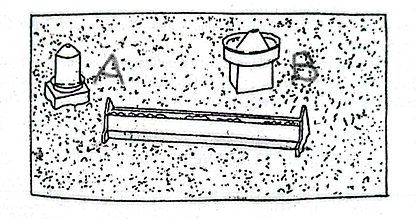
The figure is an illustration of two devices A and B used on an animal farm for rearing poultry. Study it carefully and answer the questions that follow: (i) Identify each of the devices in the farm labelled A and B (ii) Explain why the device labelled A is always placed on a platform (iii) Give two ways of maintaining device B
Diagram for question 58
59. [4]

BECE mock · Science

(i) What is a living cell? (ii) List three organelles present in animal cells
60. [5]

BECE mock · Science

(i) Define resistance of a conductor (ii) A 12 V battery is connected in series with a key and two resistors of resistances 2 ohms and 3 ohms respectively. Calculate the current flowing through the circuit if the resistors are connected in series

More Science