Which of the following services are provided by farm animals? I. Traction for farm work II. Raw materials for shoe factory III. Raw materials for herbicides
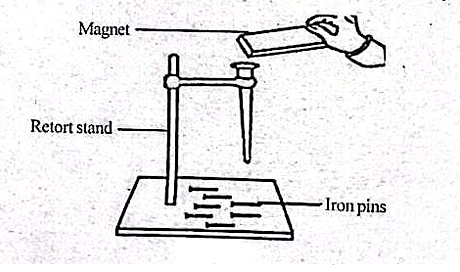
The figure illustrates how a learner magnetized a piece of long iron nail held in the arm of a retort stand with some iron pins spread on the base of the stand. Study the diagram carefully and answer the questions that follow:
(i) Name the method of magnetization demonstrated above.
(ii) State the observation that will be made when the end of the nail is touched with a magnet.
(iii) Name the type of magnet that is likely to be produced in the experiment.
(iv) Briefly explain your answer in (iii).
(v) Indicate how you will test for the polarity of the iron nail.
(vi) State two ways that magnets can lose their magnetic properties.
42.
[10]
BECE mock · Science
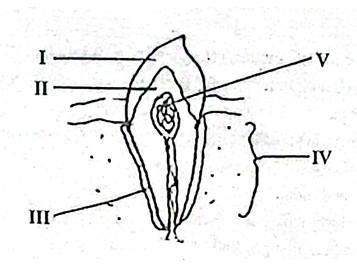
The figure is an illustration of a longitudinal section of a canine tooth in humans. Study the activities carefully and answer the questions that follow:
(i) Name each of the parts labelled I, II, III and IV.
(ii) Give the function of each parts labelled II and V.
(iii) State two symptoms of dental caries.
(iv) Suggest two ways of caring for the tooth.
43.
[10]
BECE mock · Science
The following activities were performed in the laboratory by group of pupils. Study the activities carefully and answer the questions that follow:
I. Adding half a teaspoonful of sugar to water.
II. Adding kerosene to water in a beaker.
III. A beaker was filled with water and washed sand added.
IV. Adding ethanol to water.
(i) State the observations in each of the activities carried out in I, II, III and IV.
(ii) State one method that can be used to separate each of the mixtures produced in I, II, III and IV.
(iii) Name the type of mixture produced in:
(α) I;
(β) II.
44.
[10]
BECE mock · Science
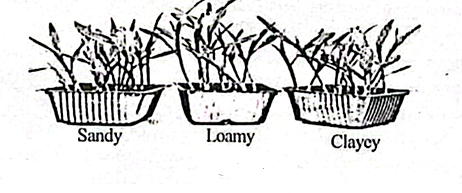
The figure illustrates an experimental set-up on effects of soil type on crop maturity stages. The pots were each filled with sandy, loamy and clayey soil and maize seeds transplanted per pot, about 2 cm deep. Study the diagram carefully and answer the questions that follow:
(i) State the common maturity stages crops go through.
(ii) State the observation that will be made in the maturity changes in each soil type.
(iii) Briefly explain how the structure of the following soil types affects the growth of crops:
(α) sandy soil;
(β) clayey soil.
(iv) Which of the soil types leads to earliest maturity?
45.
[5]
BECE mock · Science
An ammeter, A, of voltage 8 V and two resistors of resistances 4Ω and 5Ω are connected in series.
(i) Draw a circuit diagram to illustrate that arrangement.
(ii) Calculate the current in the circuit.
46.
[5]
BECE mock · Science
A biology class is studying the cheek cells of a rabbit. The learners use a microscope to observe the cells from a prepared slide.
(i) Identify three visible structures of the animal cell observed under the microscope.
(ii) State one function each of any two organelles seen in the animal cell named in 2(a)(i).
47.
[5]
BECE mock · Science
(i) State the electrical charges on the sub-atomic particles.
(ii) Briefly explain how ions are formed.
48.
[3]
BECE mock · Science
State one use of the following farm tools:
(i) hand trowel;
(ii) wheelbarrow;
(iii) garden fork.
49.
[2]
BECE mock · Science
Give two properties that are peculiar to the planet Jupiter.
50.
[5]
BECE mock · Science
A poultry and cattle farm in Kumasi wants to improve its animal production by optimizing feed management. The farm raises three types of animals: broiler chickens, dairy cows and pigs.
(i) State the appropriate feed type of each of the animals raised.
(ii) Identify the main nutrient(s) in any two each feed type named in 3(a)(i).
51.
[4]
BECE mock · Science
(i) Define inertia.
(ii) Give three practical examples of inertia.
52.
[6]
BECE mock · Science
(i) Briefly explain the following processes in nitrogen cycle:
(α) ammonification;
(β) nitrification.
(ii) State two importance of nitrogen to the environment.
53.
[2]
BECE mock · Science
Explain how deoxygenated blood is oxygenated through inhalation.
54.
[3]
BECE mock · Science
(i) What is salt?
(ii) Write the balanced chemical equation to illustrate the reaction between each of the following pairs of substances:
(α) zinc and hydrochloric acid;
(β) sodium hydroxide and sulphuric acid.
55.
[4]
BECE mock · Science
Describe how the end-product of digestion of fats and oils is absorbed in humans.
(ii) State two ways in which fats and oils are important to the human body.
56.
[2]
BECE mock · Science
Differentiate between science and technology.
57.
[4]
BECE mock · Science
(i) Explain each of the following terms as associated with simple machines:
(α) load;
(β) efficiency.
(ii) Explain briefly the charging and discharging action of capacitor.
58.
[5]
BECE mock · Science
(i) Distinguish between green manure and farmyard manure.
(ii) State the ways in which organic fertilizers are important to the soil.
59.
[5]
BECE mock · Science
(i) Classify the following compounds as covalent or ionic: NaCl, Na2O and NH3.
(ii) Explain why ionic compounds have higher boiling points than covalent compounds.
60.
[3]
BECE mock · Science
(i) Define atomic number of an atom.
(ii) An atom has 6 protons and 9 neutrons in its nucleus. Calculate the mass number.
61.
[4]
BECE mock · Science
State two symptoms of each of the following diseases:
(i) cancer;
(ii) meningitis.
62.
[5]
BECE mock · Science
(i) Distinguish between renewable and non-renewable sources of energy.
(ii) Briefly explain the processes that a dammed river uses to produce electricity.
63.
[4]
BECE mock · Science
State two advantages of each of the following farming systems:
(i) mixed cropping;
(ii) organic farming.
64.
[4]
BECE mock · Science
(i) Explain solar system.
(ii) Give two differences between asteroids and comets.