BECE mock exam

Science — DAS November 2026 Science

93 questions to work through. Answer them here, or take the whole thing timed with an account.

1. [1]

BECE mock · Science

A liquid is poured from a beaker into a measuring cylinder. Which property remains unchanged?
2. [1]

BECE mock · Science

Which structure controls the activities of a typical plant or animal cell?
3. [1]

BECE mock · Science

A green leaf is kept in darkness. Which process is directly limited by the absence of light?
4. [1]

BECE mock · Science

Two elements have atomic numbers 9 and 10. In the periodic table, the element with atomic number 9 is placed
5. [1]

BECE mock · Science

A mixture of sand and salt solution is filtered. The filtrate contains
6. [1]

BECE mock · Science

A neutral atom contains 12 protons. How many electrons does it contain?
7. [1]

BECE mock · Science

Which observation distinguishes a suspension from a colloid under normal conditions?
8. [1]

BECE mock · Science

A bacterial cell is classified as prokaryotic because it
9. [1]

BECE mock · Science

Water droplets form on the outside of a cold bottle. The droplets result mainly from
10. [1]

BECE mock · Science

Which stage follows the larva in the house fly life cycle?
11. [1]

BECE mock · Science

Which practice supplies organic plant nutrients to a school garden?
12. [1]

BECE mock · Science

Which product is obtained directly from a laying hen?
13. [1]

BECE mock · Science

Burning vegetation releases carbon dioxide. Which process helps return this carbon to green plants?
14. [1]

BECE mock · Science

A container of stagnant water is left uncovered. Which mosquito stages can develop in it?
15. [1]

BECE mock · Science

Vegetables are to be grown on waterlogged soil. Which seed bed is most suitable?
16. [1]

BECE mock · Science

Grass and hay are classified as roughage mainly because they contain much
17. [1]

BECE mock · Science

Most soluble products of digestion enter the bloodstream through the walls of the
18. [1]

BECE mock · Science

Which sequence correctly shows the inner planets moving away from the Sun?
19. [1]

BECE mock · Science

Which pair consists only of non-living components of an ecosystem?
20. [1]

BECE mock · Science

A farmer grows maize and keeps goats on the same farm. This system is
21. [1]

BECE mock · Science

Which feature makes a canine tooth suitable for tearing food?
22. [1]

BECE mock · Science

Which group consists only of outer planets?
23. [1]

BECE mock · Science

In the food chain maize → grasshopper → lizard, the grasshopper is the
24. [1]

BECE mock · Science

One useful link between crop and animal production on a farm is that
25. [1]

BECE mock · Science

A metal spoon becomes hot when left in hot soup. Heat reaches the handle mainly by
26. [1]

BECE mock · Science

In a first-class lever, the fulcrum is positioned
27. [1]

BECE mock · Science

A force of 25 N moves a box 2 m in the direction of the force. The work done is
28. [1]

BECE mock · Science

A stretched bow stores energy mainly as
29. [1]

BECE mock · Science

Which pair consists only of renewable energy sources?
30. [1]

BECE mock · Science

A thermometer is used to measure
31. [1]

BECE mock · Science

A capacitor in a simple electronic circuit is used mainly to
32. [1]

BECE mock · Science

The north pole of one magnet is brought near the north pole of another. They
33. [1]

BECE mock · Science

Which practice most directly prevents flies from contaminating cooked food?
34. [1]

BECE mock · Science

A child needs nutrients for growth and repair of damaged tissues. Which food is a useful protein source?
35. [1]

BECE mock · Science

Which action reduces unnecessary electrical energy use in a classroom?
36. [1]

BECE mock · Science

Bees obtain nectar from flowers while transferring pollen between flowers. This relationship is
37. [1]

BECE mock · Science

Which waste-management practice allows suitable organic matter to be returned to the soil?
38. [1]

BECE mock · Science

Which of the following diseases is caused by a virus?
39. [1]

BECE mock · Science

Which activity helps reduce the build-up of carbon dioxide in the atmosphere?
40. [1]

BECE mock · Science

The natural place where an organism lives is its
41. [3]

BECE mock · Science

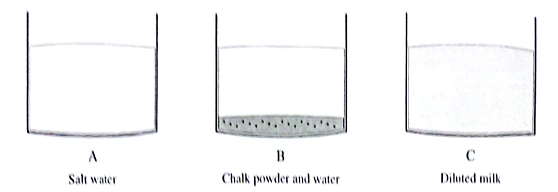
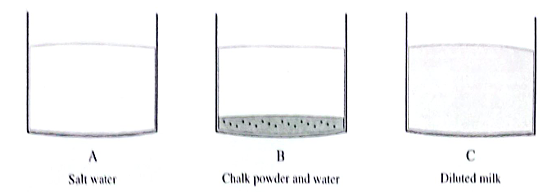
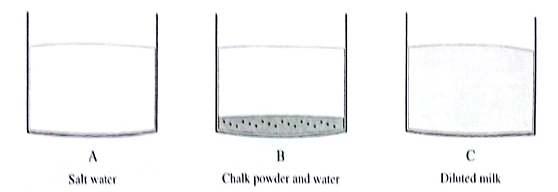
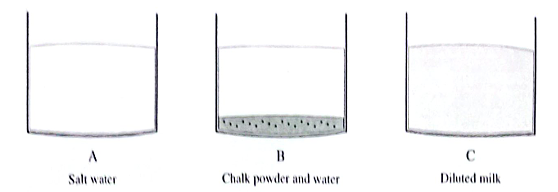
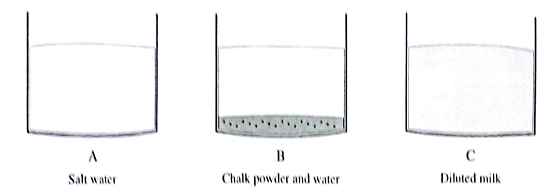
Study mixtures A, B and C after they have been left undisturbed. A: salt water; B: chalk powder and water; C: diluted milk. (i) Classify A, B and C as a true solution, a suspension or a colloid.
Diagram for question 41
42. [2]

BECE mock · Science

Study mixtures A, B and C after they have been left undisturbed. A: salt water; B: chalk powder and water; C: diluted milk. (ii) Compare B and C in terms of settling on standing.
Diagram for question 42
43. [2]

BECE mock · Science

Study mixtures A, B and C after they have been left undisturbed. A: salt water; B: chalk powder and water; C: diluted milk. (iii) Compare B and C in terms of separation by ordinary filter paper.
Diagram for question 43
44. [1]

BECE mock · Science

Study mixtures A, B and C after they have been left undisturbed. A: salt water; B: chalk powder and water; C: diluted milk. (iv) Name a method suitable for separating the chalk particles from water in B.
Diagram for question 44
45. [2]

BECE mock · Science

Study mixtures A, B and C after they have been left undisturbed. A: salt water; B: chalk powder and water; C: diluted milk. (v) Explain why mixture A is described as homogeneous.
Diagram for question 45
46. [4]

BECE mock · Science

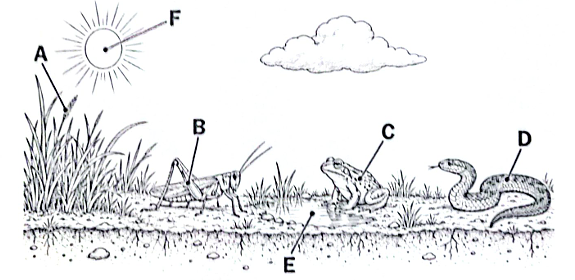
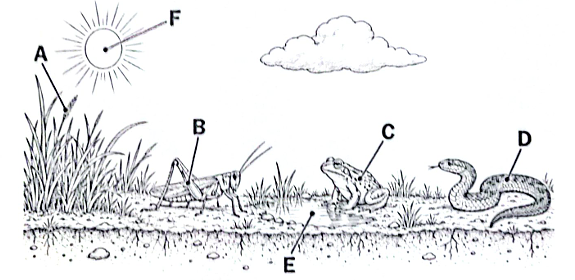
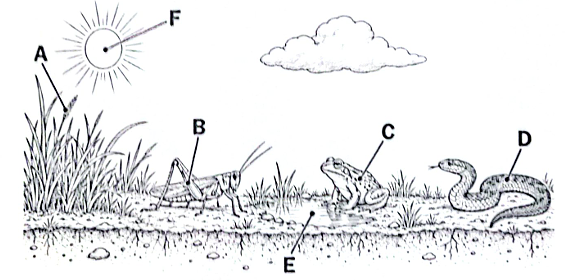
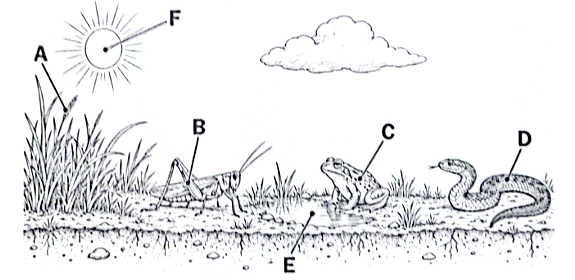
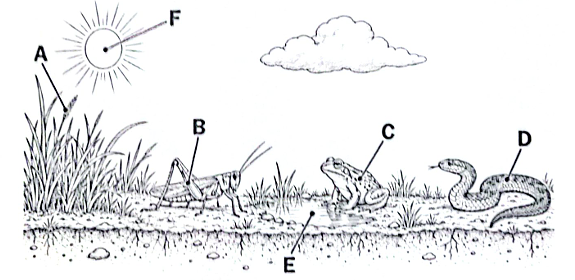
Study the labelled ecosystem. Assume that B feeds on A, C feeds on B, and D feeds on C. Organisms are enlarged for identification. (i) Name the organisms labelled A, B, C and D.
Diagram for question 46
47. [2]

BECE mock · Science

Study the labelled ecosystem. Assume that B feeds on A, C feeds on B, and D feeds on C. Organisms are enlarged for identification. (ii) Identify the primary producer and give one reason for your answer.
Diagram for question 47
48. [1]

BECE mock · Science

Study the labelled ecosystem. Assume that B feeds on A, C feeds on B, and D feeds on C. Organisms are enlarged for identification. (iii) Identify the primary consumer.
Diagram for question 48
49. [1]

BECE mock · Science

Study the labelled ecosystem. Assume that B feeds on A, C feeds on B, and D feeds on C. Organisms are enlarged for identification. (iv) Identify the secondary consumer.
Diagram for question 49
50. [2]

BECE mock · Science

Study the labelled ecosystem. Assume that B feeds on A, C feeds on B, and D feeds on C. Organisms are enlarged for identification. (v) State one importance each of E and F to organisms in A.
Diagram for question 50
51. [2]

BECE mock · Science

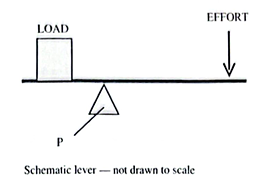
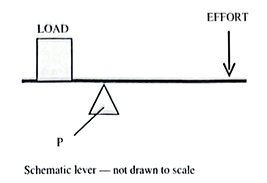
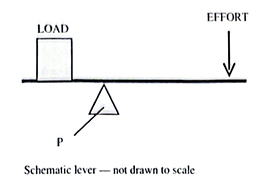
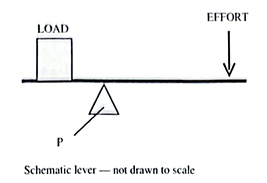
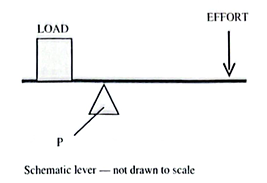
The diagram represents a lever. An effort of 20 N moves through 0.50 m while a load of 60 N is raised through 0.10 m. (i) Name P and state the class of lever shown.
Diagram for question 51
52. [2]

BECE mock · Science

The diagram represents a lever. An effort of 20 N moves through 0.50 m while a load of 60 N is raised through 0.10 m. (ii) Give two examples of levers of this class.
Diagram for question 52
53. [2]

BECE mock · Science

The diagram represents a lever. An effort of 20 N moves through 0.50 m while a load of 60 N is raised through 0.10 m. (iii) Calculate the work input.
Diagram for question 53
54. [2]

BECE mock · Science

The diagram represents a lever. An effort of 20 N moves through 0.50 m while a load of 60 N is raised through 0.10 m. (iv) Calculate the useful work output.
Diagram for question 54
55. [2]

BECE mock · Science

The diagram represents a lever. An effort of 20 N moves through 0.50 m while a load of 60 N is raised through 0.10 m. (v) Calculate the efficiency of the lever.
Diagram for question 55
56. [2]

BECE mock · Science

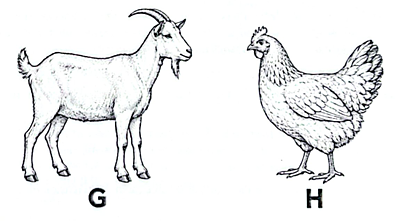
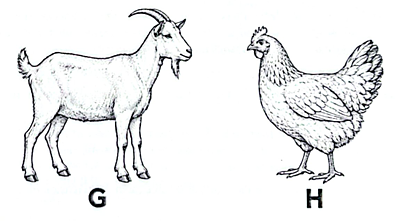
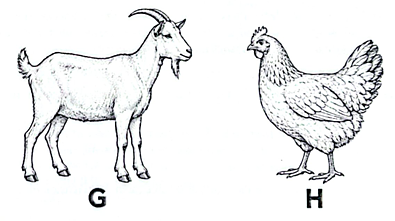
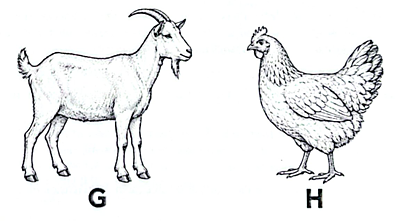
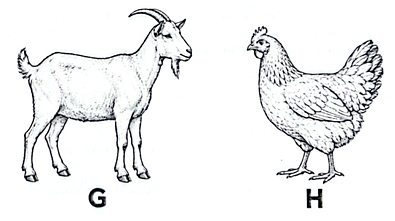
Study the two farm animals illustrated below, labelled G and H. (i) Identify the animals labelled G and H.
Diagram for question 56
57. [2]

BECE mock · Science

Study the two farm animals illustrated below, labelled G and H. (ii) Give one suitable example of feed for each animal.
Diagram for question 57
58. [2]

BECE mock · Science

Study the two farm animals illustrated below, labelled G and H. (iii) Name one nutrient supplied by each feed named in (ii).
Diagram for question 58
59. [2]

BECE mock · Science

Study the two farm animals illustrated below, labelled G and H. (iv) State one breed each of G and H.
Diagram for question 59
60. [2]

BECE mock · Science

Study the two farm animals illustrated below, labelled G and H. (v) State two reasons why farm animals need water.
Diagram for question 60
61. [2]

BECE mock · Science

A farmer cultivated maize on the same land for several years and noticed declining yields. An agricultural officer advised him to plant maize, cowpea and cassava in successive seasons. (a)(i) Identify and explain the farming practice recommended.
62. [3]

BECE mock · Science

A farmer cultivated maize on the same land for several years and noticed declining yields. An agricultural officer advised him to plant maize, cowpea and cassava in successive seasons. (a)(ii) Explain how this practice could improve soil fertility.
63. [3]

BECE mock · Science

A scientist investigating the composition of an unknown neutral atom, X, discovered that it has an atomic number of 11 and a mass number of 23. The scientist wants to determine the structure of the atom and predict its position in the modern periodic table. (b)(i) Calculate the number of protons, electrons and neutrons in atom X. Show how you obtained the number of neutrons.
64. [3]

BECE mock · Science

A scientist investigating the composition of an unknown neutral atom, X, discovered that it has an atomic number of 11 and a mass number of 23. The scientist wants to determine the structure of the atom and predict its position in the modern periodic table. (b)(ii) Determine the electron arrangement of atom X in shells and use it to identify the group to which the element belongs in the modern periodic table.
65. [2]

BECE mock · Science

During a community clean-up exercise, Akosua washed some clothes and spread them outside. Although the clothes were not exposed to direct sunlight, they became dry after some hours. Meanwhile, her mother noticed small droplets of water forming on the underside of a cool metal lid placed over a pot containing hot water. (c)(i) Identify and explain the scientific process that caused Akosua’s clothes to become dry.
66. [3]

BECE mock · Science

During a community clean-up exercise, Akosua washed some clothes and spread them outside. Although the clothes were not exposed to direct sunlight, they became dry after some hours. Meanwhile, her mother noticed small droplets of water forming on the underside of a cool metal lid placed over a pot containing hot water. (c)(ii) Identify and explain the scientific process responsible for the formation of water droplets beneath the lid.
67. [2]

BECE mock · Science

During a microscope practical, a learner observed two different cells. Cell A had a cell membrane but no chloroplasts, while Cell B had both structures. Explain how each of the following structures contributes to the survival of a living cell. (d)(i) Cell membrane.
68. [2]

BECE mock · Science

During a microscope practical, a learner observed two different cells. Cell A had a cell membrane but no chloroplasts, while Cell B had both structures. Explain how each of the following structures contributes to the survival of a living cell. (d)(ii) Chloroplast.
69. [3]

BECE mock · Science

A Basic 8 learner frequently eats large pieces of boiled yam without chewing them properly. One afternoon, the learner complained of discomfort after eating. During a science lesson, the teacher explained that food must undergo certain processes before the body can absorb and use its nutrients. (a)(i) Explain the process of digestion, using the learner’s experience to support your answer.
70. [3]

BECE mock · Science

A Basic 8 learner frequently eats large pieces of boiled yam without chewing them properly. One afternoon, the learner complained of discomfort after eating. During a science lesson, the teacher explained that food must undergo certain processes before the body can absorb and use its nutrients. (a)(ii) Explain two reasons why the food eaten by the learner must be digested before its nutrients can be used by the body.
71. [2]

BECE mock · Science

A space research club at a Junior High School is preparing a model of the solar system. The learners have correctly positioned the four inner planets but are confused about the arrangement of Jupiter, Saturn, Uranus and Neptune. Using your knowledge of the solar system: (b)(i) Identify the two outer planets nearest to the Sun and arrange them in increasing order of distance from the Sun.
72. [2]

BECE mock · Science

A space research club at a Junior High School is preparing a model of the solar system. The learners have correctly positioned the four inner planets but are confused about the arrangement of Jupiter, Saturn, Uranus and Neptune. Using your knowledge of the solar system: (b)(ii) Identify the two outer planets farthest from the Sun and arrange them in increasing order of distance from the Sun.
73. [2]

BECE mock · Science

A farmer in a rural community keeps goats and poultry while cultivating maize, cassava and vegetables on the same farm. The farmer uses some crop residues to feed the animals and applies animal manure to improve soil fertility. (c)(i) Identify and explain the farming system being practised by the farmer.
74. [4]

BECE mock · Science

A farmer in a rural community keeps goats and poultry while cultivating maize, cassava and vegetables on the same farm. The farmer uses some crop residues to feed the animals and applies animal manure to improve soil fertility. (c)(ii) Explain four ways in which this farming system could improve the farmer’s productivity, income or use of farm resources.
75. [2]

BECE mock · Science

Ama accidentally mixed some iron nails with gari while preparing food. She wants to separate the nails without wasting the gari. (d)(i) Identify a suitable method for separating the mixture.
76. [2]

BECE mock · Science

Ama accidentally mixed some iron nails with gari while preparing food. She wants to separate the nails without wasting the gari. (d)(ii) Explain how Ama would use this method to separate the nails from the gari.
77. [3]

BECE mock · Science

During the arrangement of furniture in a classroom, two learners attempted to move a heavy box. The first learner applied a force of 15 N horizontally and successfully moved the box through a distance of 4 m in the direction of the force. The second learner pushed against a wall with considerable force, but the wall did not move. (a)(i) Explain the scientific meaning of work and use it to determine whether the second learner performed mechanical work on the wall.
78. [3]

BECE mock · Science

During the arrangement of furniture in a classroom, two learners attempted to move a heavy box. The first learner applied a force of 15 N horizontally and successfully moved the box through a distance of 4 m in the direction of the force. The second learner pushed against a wall with considerable force, but the wall did not move. (a)(ii) Calculate the work done by the first learner in moving the box. Show the formula, substitution and appropriate SI unit.
79. [2]

BECE mock · Science

While preparing a meal, a mother left a metal spoon in a pot of hot soup. After some minutes, the handle of the spoon became hot even though it was not directly in the soup. (b)(i) Identify and explain the method of heat transfer responsible for this observation.
80. [2]

BECE mock · Science

While preparing a meal, a mother left a metal spoon in a pot of hot soup. After some minutes, the handle of the spoon became hot even though it was not directly in the soup. (b)(ii) Explain how the same method of heat transfer is applied in one other household activity.
81. [2]

BECE mock · Science

A school located in a community with an unreliable electricity supply installed solar photovoltaic panels to power its classrooms. The school also uses an electric iron to press uniforms during special programmes. Explain the main energy transformation that occurs when: (c)(i) The solar photovoltaic panels generate electricity.
82. [2]

BECE mock · Science

A school located in a community with an unreliable electricity supply installed solar photovoltaic panels to power its classrooms. The school also uses an electric iron to press uniforms during special programmes. Explain the main energy transformation that occurs when: (c)(ii) The electric iron is switched on and becomes hot.
83. [6]

BECE mock · Science

During an inspection of a school’s agricultural and science equipment, the teacher discovered that some cutlasses had become rusty, a hoe had a loose handle, and several laboratory tools were dirty after use. As the leader of the school’s equipment maintenance team, describe three practical measures you would introduce to maintain these tools and explain how each measure would help prolong their usefulness.
84. [4]

BECE mock · Science

Residents of a community have reported increasing cases of malaria, especially among children. During an environmental inspection, health workers discovered discarded tyres, uncovered containers containing stagnant water, and blocked drains around several houses. They also found mosquito larvae in some of the water containers. (a)(i) Arrange the four stages in the life cycle of a mosquito in their correct sequence.
85. [2]

BECE mock · Science

Residents of a community have reported increasing cases of malaria, especially among children. During an environmental inspection, health workers discovered discarded tyres, uncovered containers containing stagnant water, and blocked drains around several houses. They also found mosquito larvae in some of the water containers. (a)(ii) Explain one practical action the residents could take to interrupt the mosquito life cycle and reduce mosquito breeding.
86. [2]

BECE mock · Science

Two farmers in different communities want to establish vegetable nurseries. Farmer A has a plot of land that becomes waterlogged during heavy rainfall, while Farmer B has a garden where the soil drains very quickly and loses moisture during the dry season. (b)(i) Identify the most suitable type of seed bed for each farmer.
87. [3]

BECE mock · Science

Two farmers in different communities want to establish vegetable nurseries. Farmer A has a plot of land that becomes waterlogged during heavy rainfall, while Farmer B has a garden where the soil drains very quickly and loses moisture during the dry season. (b)(ii) Justify your recommendation for each farmer by explaining how the selected seed bed would help address the soil or moisture conditions.
88. [1]

BECE mock · Science

During a science practical lesson, Kofi constructed an electronic circuit using a battery, capacitor, LED, diode and resistor. He observed that the LED remained lit briefly after the battery was disconnected. Using your knowledge of electronic circuits, answer the following questions. Explain the function of each of the following components in the circuit: (c)(i) Light Emitting Diode (LED).
89. [1]

BECE mock · Science

During a science practical lesson, Kofi constructed an electronic circuit using a battery, capacitor, LED, diode and resistor. He observed that the LED remained lit briefly after the battery was disconnected. Using your knowledge of electronic circuits, answer the following questions. Explain the function of each of the following components in the circuit: (c)(ii) Diode.
90. [1]

BECE mock · Science

During a science practical lesson, Kofi constructed an electronic circuit using a battery, capacitor, LED, diode and resistor. He observed that the LED remained lit briefly after the battery was disconnected. Using your knowledge of electronic circuits, answer the following questions. Explain the function of each of the following components in the circuit: (c)(iii) Resistor.
91. [3]

BECE mock · Science

During a science practical lesson, three learners prepared different mixtures. Ama mixed sand with gravel, Kofi mixed sand with water, and Esi mixed oil with water. They stirred the mixtures and allowed them to stand for some minutes. (d)(i) Classify each of the three mixtures as homogeneous or heterogeneous.
92. [2]

BECE mock · Science

During a science practical lesson, three learners prepared different mixtures. Ama mixed sand with gravel, Kofi mixed sand with water, and Esi mixed oil with water. They stirred the mixtures and allowed them to stand for some minutes. (d)(ii) Explain two observations that support your classification of the mixtures.
93. [1]

BECE mock · Science

During a science practical lesson, three learners prepared different mixtures. Ama mixed sand with gravel, Kofi mixed sand with water, and Esi mixed oil with water. They stirred the mixtures and allowed them to stand for some minutes. (d)(iii) Suggest one method of separating the sand from the water.

More Science