BECE mock exam

Science — Best Brain March 2026 Science

90 questions to work through. Answer them here, or take the whole thing timed with an account.

1. [1]

BECE mock · Science

Which planet is known as Earth's twin due to its similar size and composition?
2. [1]

BECE mock · Science

Which of the following actions can help reduce your carbon footprint?
3. [1]

BECE mock · Science

Which of the following best describes biodiversity?
4. [1]

BECE mock · Science

Which part of the ear is responsible for converting sound vibrations into neural signals?
5. [1]

BECE mock · Science

Sodium hydroxide is a key ingredient in soap making because it
6. [1]

BECE mock · Science

How does elevation affect climate?
7. [1]

BECE mock · Science

Which breed of cattle is primarily raised for milk production?
8. [1]

BECE mock · Science

A major reservoir of carbon in the carbon cycle is
9. [1]

BECE mock · Science

When groundnut paste is mixed with water the mixture formed is
10. [1]

BECE mock · Science

A common breed of pig known for its rapid growth and good meat quality is
11. [1]

BECE mock · Science

In the water cycle precipitation refers to
12. [1]

BECE mock · Science

The primary diet of housefly larvae is
13. [1]

BECE mock · Science

The fish species which is widely farmed in freshwater aquaculture is
14. [1]

BECE mock · Science

The nymph of a grasshopper: I. is smaller than the adult. II. do not feed on anything. III. molts several times into adulthood. IV. do not have fully developed wings.
15. [1]

BECE mock · Science

In a closed system the total amount of energy
16. [1]

BECE mock · Science

The most vital nutrient in poultry feed is
17. [1]

BECE mock · Science

The planet Mercury: I. is largest planet in our solar system. II. is the closest planet to the Sun. III. has no moons or rings. IV. is covered in a layer of dust.
18. [1]

BECE mock · Science

The primary consideration when selecting feed for a dairy cow is
19. [1]

BECE mock · Science

If more resistors are added in series in a circuit the total resistance
20. [1]

BECE mock · Science

The role of minerals in animal feed is to
21. [1]

BECE mock · Science

The mechanical advantage of a pulley system is determined by the
22. [1]

BECE mock · Science

Which color of light has the longest wavelength?
23. [1]

BECE mock · Science

The pitch of a sound is determined by its
24. [1]

BECE mock · Science

The unit of measurement for the loudness of sound is
25. [1]

BECE mock · Science

High biodiversity typically indicates
26. [1]

BECE mock · Science

Which of the following human activities is a major threat to biodiversity?
27. [1]

BECE mock · Science

The process that powers the sun is called
28. [1]

BECE mock · Science

Which type of climate is typically found at high altitudes?
29. [1]

BECE mock · Science

The sperm cell is a specialized cell that: I. is covered by a cap-like structure. II. has a nucleus that contains genetic material. III. It has a long whip-like tail. IV. is small and streamlined.
30. [1]

BECE mock · Science

One characteristic of a well-prepared seed bed is
31. [1]

BECE mock · Science

When an object is in forward bias in an electronic circuit
32. [1]

BECE mock · Science

Which digestive organ produces insulin?
33. [1]

BECE mock · Science

Which planet has a day longer than its year?
34. [1]

BECE mock · Science

Which of the following is a form of potential energy?
35. [1]

BECE mock · Science

A wedge is used to
36. [1]

BECE mock · Science

Sound energy travels fastest through
37. [1]

BECE mock · Science

Kinetic energy depends on
38. [1]

BECE mock · Science

Which inner planet has no atmosphere?
39. [1]

BECE mock · Science

The layer of the sun that we can see is the
40. [1]

BECE mock · Science

According to Newton's Third Law: I. every action has an effect. II. for every effect there is a cause. III. there is no action without a corresponding reaction.
41. [3]

BECE mock · Science

Study the table on atomic elements and complete it by supplying the missing atomic numbers, element names, symbols, electronic configurations, and valence electrons.
Diagram for question 41
42. [3]

BECE mock · Science

Study the table on atomic elements and draw the electronic structures of the elements with atomic numbers 1 and 8.
Diagram for question 42
43. [2]

BECE mock · Science

If the elements with atomic numbers 1 and 8 lose and gain their outermost electrons respectively, give the symbols of the ions formed.
Diagram for question 43
44. [2]

BECE mock · Science

A compound commonly found in everyday life is formed between the elements with atomic numbers 1 and 8. Write a word equation and a balanced chemical equation for the reaction.
Diagram for question 44
45. [3]

BECE mock · Science

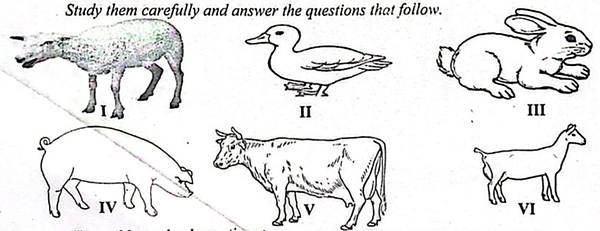
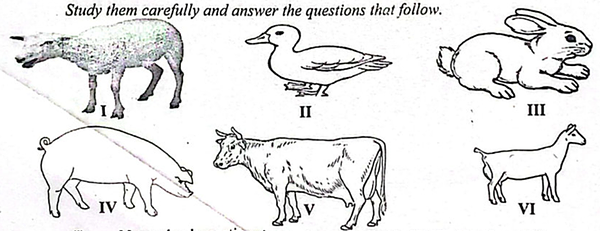
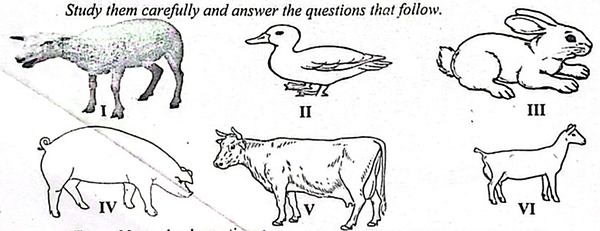
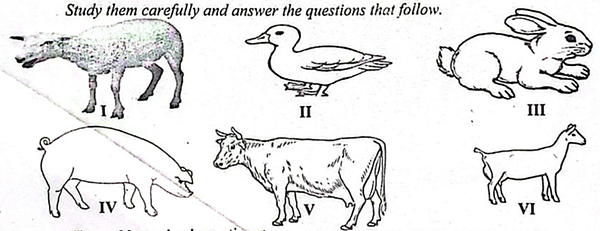
The diagrams show domestic animals labelled I, II, III, IV, V and VI. Name the animals and give one example of a breed for each.
Diagram for question 45
46. [3]

BECE mock · Science

The diagrams show domestic animals labelled I and VI. State three differences between animal I and animal VI.
Diagram for question 46
47. [2]

BECE mock · Science

The diagrams show domestic animals labelled IV and V. Give the difference between the digestive systems of animal IV and animal V.
Diagram for question 47
48. [2]

BECE mock · Science

The diagrams show domestic animals. State four commercial uses of domestic animals.
Diagram for question 48
49. [2]

BECE mock · Science

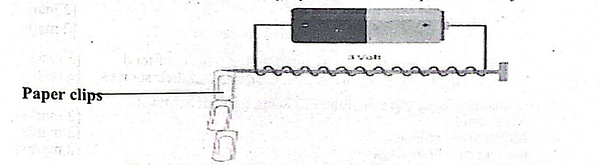
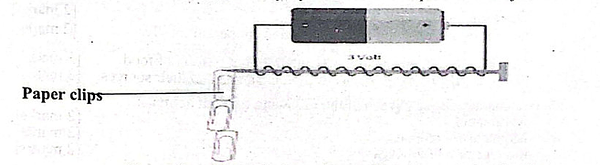
The diagram illustrates an experiment to show the relationship between magnetism and Newton’s Second Law of Motion. State Newton’s Second Law of Motion and give the factors that affect how fast the paper clips accelerate towards the nail.
Diagram for question 49
50. [2]

BECE mock · Science

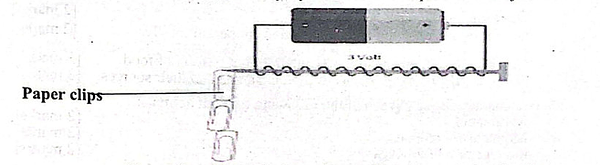
In the magnetism experiment shown, what is the role of the battery in the circuit?
Diagram for question 50
51. [2]

BECE mock · Science

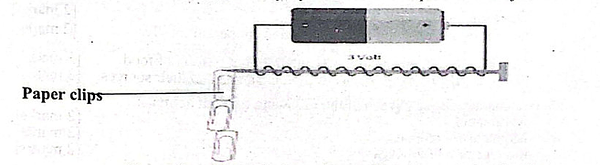
In the magnetism experiment shown, explain how the distance between the nail and the paper clips affects the force acting on the paper clips.
Diagram for question 51
52. [2]

BECE mock · Science

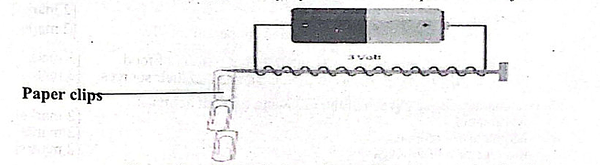
In the magnetism experiment shown, what happens if the paper clips are replaced with a coin of twice the mass while keeping the same coils around the nail and the same voltage?
Diagram for question 52
53. [2]

BECE mock · Science

In the magnetism experiment shown, state the law of magnetism and give two industrial uses of magnets.
Diagram for question 53
54. [2]

BECE mock · Science

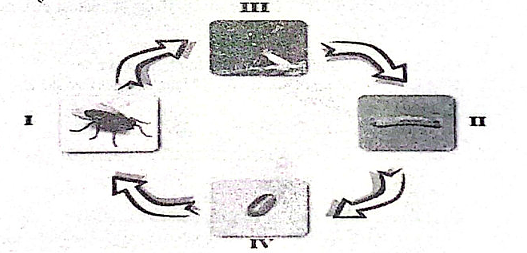
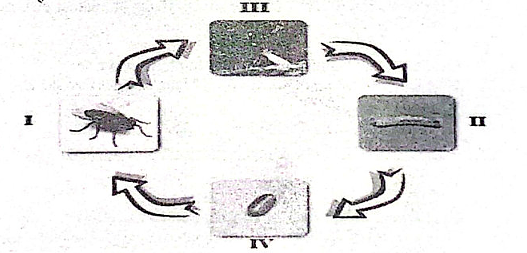
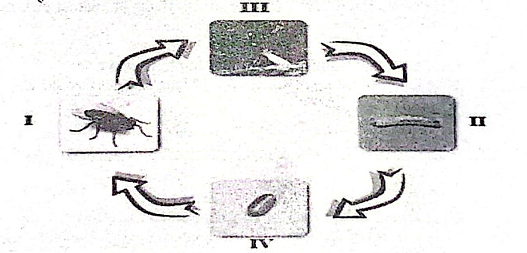
The diagram shows the metamorphosis of a housefly. Explain why the metamorphosis shown is complete or incomplete.
Diagram for question 54
55. [2]

BECE mock · Science

The diagram shows the metamorphosis of a housefly. Identify the stages labelled I, II, III and IV.
Diagram for question 55
56. [2]

BECE mock · Science

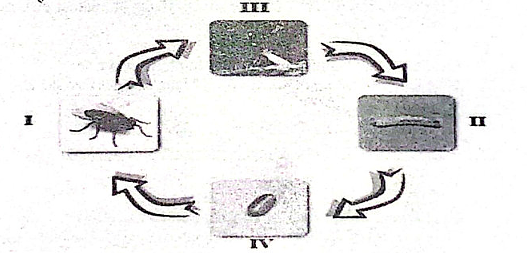
The diagram shows the metamorphosis of a housefly. Identify four breeding places of houseflies.
Diagram for question 56
57. [2]

BECE mock · Science

The diagram shows the metamorphosis of a housefly. List four diseases that are caused by the activities of the housefly.
Diagram for question 57
58. [2]

BECE mock · Science

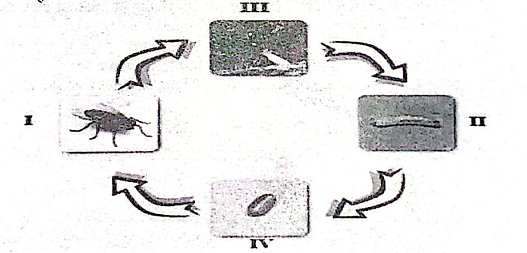
The diagram shows the metamorphosis of a housefly. Give two ways to control the effects of houseflies on humans.
Diagram for question 58
59. [2]

BECE mock · Science

Differentiate between hail and sleet.
60. [2]

BECE mock · Science

Give four reasons why the water cycle is important in life.
61. [3]

BECE mock · Science

Describe what happens in the mouth during digestion of food.
62. [3]

BECE mock · Science

Name the three end products of food digestion and their sources.
63. [2]

BECE mock · Science

State two characteristics of ruminants.
64. [2]

BECE mock · Science

State two characteristics of monogastric animals.
65. [2]

BECE mock · Science

State two characteristics of monogastric herbivores.
66. [2]

BECE mock · Science

An object situated at a height of 8 m has a potential energy of 170 J. Find the mass of the body, taking g = 10 m/s².
67. [2]

BECE mock · Science

An object situated at a height of 8 m has a potential energy of 170 J. If the object has a velocity of 9 m/s, determine its kinetic energy.
68. [4]

BECE mock · Science

Draw the waste management pyramid and explain two good waste management practices.
69. [2]

BECE mock · Science

State four impacts of waste substances on the environment.
70. [2]

BECE mock · Science

Distinguish between autotrophic and heterotrophic nutrition.
71. [4]

BECE mock · Science

Explain symbiosis and describe the three main types of symbiotic relationships in an ecosystem.
72. [2]

BECE mock · Science

What is organic farming?
73. [2]

BECE mock · Science

Give two differences between organic farming and conventional systems of farming.
74. [2]

BECE mock · Science

Explain the difference between nuclear fusion and nuclear fission.
75. [2]

BECE mock · Science

Give two ways to reduce the negative effects of nuclear electric power generation on the environment.
76. [2]

BECE mock · Science

Give two adaptations of a woodpecker to life on trees.
77. [4]

BECE mock · Science

Give four adaptations of fish for living in aquatic ecosystems.
78. [2]

BECE mock · Science

What are isotopes?
79. [2]

BECE mock · Science

Give two examples of isotopes.
80. [2]

BECE mock · Science

Describe how a spade is used as an agricultural tool.
81. [2]

BECE mock · Science

Describe how a mattock is used as an agricultural tool.
82. [4]

BECE mock · Science

Give two advantages of using solar energy as an energy source.
83. [4]

BECE mock · Science

State two disadvantages of using solar energy as an energy source.
84. [2]

BECE mock · Science

What are electrovalent compounds?
85. [2]

BECE mock · Science

Give two examples of electrovalent compounds.
86. [4]

BECE mock · Science

Give four industrial uses of bacteria.
87. [2]

BECE mock · Science

Mention two natural causes of climate change.
88. [4]

BECE mock · Science

State four effects of global warming.
89. [3]

BECE mock · Science

Mention three warning signs of periodontal disease.
90. [3]

BECE mock · Science

Mention three ways of keeping the teeth clean.

More Science