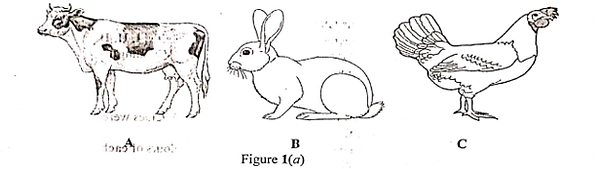
1. (a) Figure 1(a) is an illustration of three types of domestic farm animals. Study the figure carefully and answer the questions that follow.
(i) Mention one type of feed given to each of the animals labelled A, B and C.
(ii) Name one nutrient each from the types of feed mentioned in (i).
(iii) Give one function each of the nutrient named in (ii).
(iv) Which of the animals in Fig. 1(a) can be classified as a ruminant?
2.
[10]
BECE 2026 · Paper 2
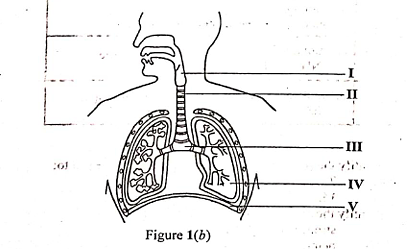
1. (b) Figure 1(b) is an illustration of the respiratory system of humans. Study the figure carefully and answer the questions that follow.
(i) Name the parts labelled I, II, III, IV and V.
(ii) Give one function each of the parts labelled III and V.
(iii) Name the most important gas during the process of respiration that is:
(α) used by the body;
(β) brought out from the body.
3.
[10]
BECE 2026 · Paper 2
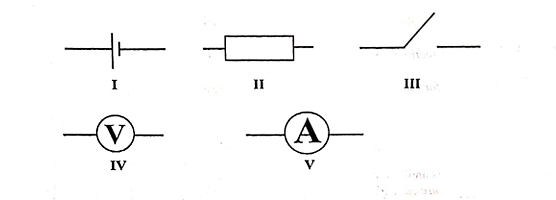
1. (c) The diagrams below are illustrations of circuit symbols of electric components used to investigate the relationship between potential difference and electric current. Study the diagrams carefully and answer the questions that follow.
(i) Name the symbols labelled I, III and V.
(ii) Draw a circuit diagram using all the symbols labelled I, II, III, IV and V.
(iii) If the circuit is closed and V reads 5 units while IV reading 1.5 units, determine the value of II in S.I. units.
4.
[10]
BECE 2026 · Paper 2
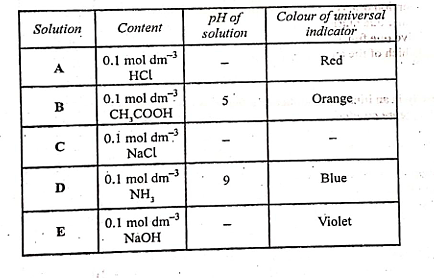
1. (d) A number of acid, base and salt solutions of different pH values were prepared in test tubes labelled A, B, C, D and E. The table below shows the pH and the corresponding colours of each solution on addition of three drops of universal indicator.
Solution A: 0.1 mol dm⁻³ HCl, pH of solution: —, Colour of universal indicator: Red
Solution B: 0.1 mol dm⁻³ CH₃COOH, pH of solution: 5, Colour of universal indicator: Orange
Solution C: 0.1 mol dm⁻³ NaCl, pH of solution: —, Colour of universal indicator: —
Solution D: 0.1 mol dm⁻³ NH₃, pH of solution: 9, Colour of universal indicator: Blue
Solution E: 0.1 mol dm⁻³ NaOH, pH of solution: —, Colour of universal indicator: Violet
(i) Identify the solution that would have a pH value equal to:
(α) 7;
(β) 14.
(ii) Identify the solutions that can be classified as a/an:
(α) strong acid;
(β) neutral;
(γ) weak base.
(iii) Suggest the pH value of solution A.
(iv) Identify two solutions in the table that will react to form salt and water.
(v) What would be the colour of solution C upon addition of drops of universal indicator.
5.
[6]
BECE 2026 · Paper 2
2. (a) Give two examples of each of the following types of diseases of humans:
(i) Fungal disease;
(ii) Deficiency disease;
(iii) Non-communicable disease.
6.
[4]
BECE 2026 · Paper 2
2. (b) Explain the following terms:
(i) Homogeneous mixture;
(ii) Heterogeneous mixture.
7.
[5]
BECE 2026 · Paper 2
2. (c) (i) Explain briefly why dragging an object on a smooth surface is easier than on a rough surface.
(ii) Name the S.I. unit of
(α) force;
(β) work.
8.
[5]
BECE 2026 · Paper 2
2. (d) (i) What is a balanced ration in poultry feed?
(ii) Give three effects of malnutrition in poultry.
9.
[4]
BECE 2026 · Paper 2
3. (a) (i) A simple electric circuit is made up of a cell, resistor and a bulb. State the observation that will be made when the number of
(α) cells is doubled;
(β) bulbs is doubled.
(ii) Explain the observation stated in (i).
10.
[6]
BECE 2026 · Paper 2
3. (b) Explain briefly how the following factors affect vegetable crop production:
(i) soil type;
(ii) nearness to source of water;
(iii) nearness to market.
11.
[4]
BECE 2026 · Paper 2
3. (c) Explain briefly the following interactions in an ecosystem:
(i) Mutualism;
(ii) Commensalism.
12.
[6]
BECE 2026 · Paper 2
3. (d) (i) Distinguish between the following chemical substances:
(α) Element and compound;
(β) Molecule and ion.
(ii) Write the chemical formula of each of the following binary compounds:
(α) Aluminium fluoride;
(β) Ammonia.
13.
[4]
BECE 2026 · Paper 2
4. (a) Name two
(i) micro-nutrients of plants;
(ii) macro-nutrients of plants.
14.
[3]
BECE 2026 · Paper 2
4. (b) Name the component of the circulatory system that performs each of the following functions:
(i) transport of nutrients;
(ii) protection of the body against infection;
(iii) temperature regulation.
15.
[3]
BECE 2026 · Paper 2
4. (c) State three effects of poor waste management on human health.
16.
[5]
BECE 2026 · Paper 2
4. (d) (i) Differentiate between a colloid and suspension.
(ii) Classify the following mixtures as solution, colloid or suspension:
(α) Groundnut paste and water;
(β) Milk and water;
(γ) Sugar and water.
17.
[5]
BECE 2026 · Paper 2
4. (e) (i) What is work output?
(ii) Explain how work output affects the efficiency of a machine if work input is fixed.
18.
[5]
BECE 2026 · Paper 2
5. (a) (i) An atom of an element is represented as ¹⁶₈X. Determine the number of
(α) Protons,
(β) Electrons,
(γ) Neutrons.
(ii) State the position of the element X in (i) on the periodic table in terms of
(α) Group;
(β) Period.
19.
[5]
BECE 2026 · Paper 2
5. (b) (i) Explain briefly heat transfer by conduction.
(ii) Name two other methods of heat transfer.
20.
[6]
BECE 2026 · Paper 2
5. (c) (i) Give two examples of water bodies.
(ii) State two practices of humans that destroy water bodies.
(iii) State two methods of conserving water bodies.
21.
[4]
BECE 2026 · Paper 2
5. (d) (i) State three ways by which bacterial diseases are managed.
(ii) Give an example of a bacterial disease.